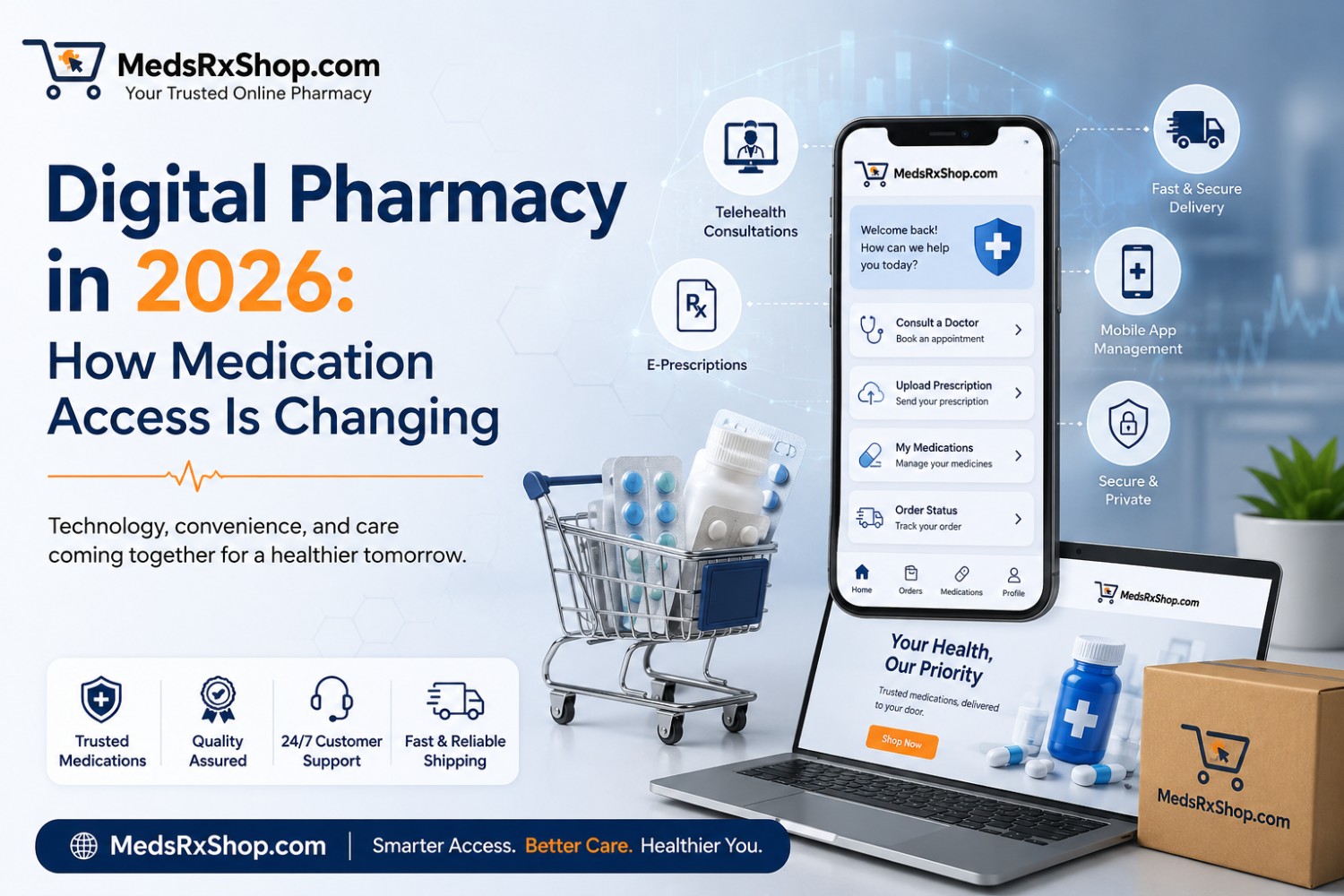
Digital Pharmacy in 2026: How Medication Access Is Changing
Healthcare is becoming more connected every year, and the way people access pharmacy services is changing along with it. In 2026, patients have more digital options for managing prescriptions, finding medication information, communicating with healthcare professionals, requesting eligible refills, and coordinating pharmacy services from the comfort of home.
For many people, this shift is about convenience. Instead of handling every part of the healthcare journey through phone calls, paperwork, and physical visits, digital tools can bring several steps together in one place.
But a digital pharmacy is about much more than ordering medication through a website.
A modern pharmacy experience also involves prescription management, professional guidance, privacy, secure technology, medication information, and reliable communication. For digital pharmacy platforms such as MedsRxShop.com, the changing healthcare environment creates an opportunity to make pharmacy-related services easier to navigate while keeping the patient experience at the center.
So, what exactly is changing in 2026, and what should patients know before choosing a digital pharmacy?
What Is a Digital Pharmacy?
A digital pharmacy uses online technology to provide or support pharmacy-related services. Depending on the pharmacy, location, and applicable regulations, these services can include prescription management, medication information, refill requests, pharmacist communication, order management, and delivery coordination.
Some digital pharmacies operate primarily online, while others combine digital services with physical pharmacy locations.
The biggest difference is often the way patients interact with the service.
For example, someone managing a recurring prescription may be able to review information, communicate with a pharmacy team, request an eligible refill, and manage certain order details digitally rather than completing every step in person.
That does not mean technology replaces healthcare professionals.
A responsible digital pharmacy still depends on pharmacists and other qualified professionals for appropriate medication guidance and prescription-related decisions. Technology simply provides another way for patients and professionals to connect.
Why Medication Access Is Changing
There are several reasons medication access is becoming more digital.
The first is simple: people value convenience.
Modern patients often balance work, family, travel, appointments, and other responsibilities. Visiting a pharmacy for every routine task can sometimes be difficult, particularly when a digital alternative is available.
Technology has also changed what people expect from everyday services. Banking, shopping, communication, and appointment management can all be handled digitally, so patients increasingly expect healthcare services to offer convenient digital options too.
However, healthcare is different from ordinary online shopping.
Medication involves professional oversight, prescription requirements, appropriate use, potential interactions, and patient-specific considerations. Therefore, the future of digital pharmacy is not simply about making medication access faster.
It is about making the overall experience more convenient without compromising responsible healthcare practices.
Telehealth and Digital Pharmacy
Telehealth is one of the biggest developments influencing modern medication access.
With telehealth, eligible patients may be able to communicate with healthcare professionals through video appointments, secure messaging, or other approved digital channels. Depending on the patient’s circumstances and applicable regulations, a healthcare professional may determine whether prescription treatment is appropriate.
This can create a more connected healthcare journey.
For example, a patient may schedule a virtual consultation, discuss a health concern with an appropriate healthcare professional, receive an electronic prescription when clinically suitable, and then work with a pharmacy to have that prescription processed.
The important point is that telehealth does not remove professional judgment. It simply provides another communication channel.
Digital pharmacy services can complement this process by helping patients manage the pharmacy-related steps that follow an appropriate consultation and prescription.
Electronic Prescriptions and Digital Records
Electronic prescriptions have become an important part of modern pharmacy systems.
Instead of relying entirely on handwritten prescription paperwork, authorized healthcare professionals can use electronic systems to transmit prescription information to pharmacies where permitted.
Digital records can also help patients keep important medication information organized.
Consider someone who takes several medications. Remembering prescription details, refill dates, appointment information, and medication instructions can become confusing.
A secure digital system can make these details easier to organize and access when needed.
For platforms such as MedsRxShop.com, digital convenience can be particularly useful when it helps users navigate pharmacy-related information more clearly.
Still, technology is only useful when the information being handled is accurate, secure, and managed responsibly.
How Mobile Apps Support Medication Management
Smartphones have become a regular part of healthcare management.
Medication-related apps and digital platforms can help patients organize reminders, prescription information, refill dates, appointments, and other healthcare tasks.
For example, someone with a recurring prescription may use a reminder to stay aware of when they need to contact their pharmacy about an eligible refill.
Digital tools can also provide easier access to information and communication channels.
However, mobile technology should be viewed as a support tool rather than a replacement for professional advice.
If a patient has questions about dosage, side effects, drug interactions, missed doses, or whether a medication is appropriate, the right approach is to contact a qualified healthcare professional.
A notification can remind someone about a task. It cannot replace individualized medical judgment.
Online Prescription Refills
Prescription refill management is another area where digital pharmacy services can make everyday healthcare more convenient.
Depending on the prescription and pharmacy, patients may be able to submit an eligible refill request through an online account or digital platform rather than calling or visiting the pharmacy.
This can save time and make recurring medication management easier to organize.
However, requesting a refill does not necessarily mean that it will automatically be approved.
The pharmacy may need to consider the prescription’s authorization, remaining refills, medication requirements, applicable regulations, and other relevant factors before processing the request.
This is why patients should be cautious of websites suggesting that every prescription medication can simply be reordered without appropriate requirements.
A trustworthy digital pharmacy experience should make these processes clear rather than creating unrealistic expectations.
Medication Delivery and Home Convenience
Medication delivery is one of the most recognizable features of digital pharmacy services.
For eligible prescriptions and services, home delivery can save patients a trip to a physical pharmacy and make routine medication management more convenient.
For someone with a busy schedule, this can be a meaningful improvement.
But convenient delivery should involve more than promising speed.
Patients should consider whether the pharmacy provides clear delivery information, order updates, appropriate packaging, customer support, and instructions for medications that may have specific storage or handling requirements.
Delivery availability can also vary depending on the medication, location, pharmacy policies, and applicable laws.
MedsRxShop.com can fit naturally into this broader digital pharmacy landscape by focusing on a user-friendly experience where customers can navigate pharmacy-related services and information more conveniently.
The goal should always be responsible access combined with convenience, rather than speed alone.
Privacy and Data Security
Digital healthcare creates another important responsibility: protecting personal information.
A pharmacy platform may handle names, contact information, prescription details, payment information, delivery information, and other sensitive data.
That makes privacy and security important considerations when choosing a digital pharmacy.
Patients should look for clear privacy information and understand how their data is collected, used, stored, and protected.
They should also take basic precautions themselves.
Using strong passwords, keeping devices updated, avoiding suspicious links, and being careful when accessing health information on shared or public devices can all help improve personal security.
For digital pharmacy businesses, privacy should not be treated as a small technical detail. It should be part of the overall patient experience.
How to Recognize a Legitimate Digital Pharmacy
One of the most important questions patients should ask is whether an online pharmacy is legitimate and operates appropriately.
A professional-looking website alone is not enough.
Patients should look for clear business information, appropriate prescription requirements, access to qualified pharmacy professionals, transparent policies, and information about the pharmacy’s authorization or licensing where applicable.
Be especially careful with websites that make unrealistic promises, hide important information, offer prescription medication without appropriate requirements, or pressure customers into making quick decisions.
Price should not be the only factor either.
An unusually low price may look attractive, but medication safety and pharmacy legitimacy are much more important considerations.
When evaluating MedsRxShop.com or any other digital pharmacy service, customers should take time to understand the available services, policies, prescription requirements, privacy information, and support options before making healthcare-related decisions.
Digital Pharmacy vs. Traditional Pharmacy
Traditional pharmacies continue to play an important role in healthcare.
They provide face-to-face interaction, direct access to pharmacy professionals, and immediate assistance for many routine questions and needs.
Digital pharmacies offer a different type of convenience.
They can make certain services accessible remotely and may allow patients to manage pharmacy-related tasks from a smartphone or computer.
Neither approach is automatically better for everyone.
Someone who needs face-to-face assistance may prefer a physical pharmacy. Another person managing a routine prescription may appreciate digital communication and eligible delivery options.
The future is likely to involve both models working together rather than one completely replacing the other.
The Role of Pharmacists in Digital Healthcare
Technology may change how patients interact with pharmacies, but pharmacists remain an essential part of medication care.
Pharmacists can help patients understand medication instructions, answer medication-related questions, identify potential concerns, and provide professional guidance within their role.
This human element is especially important when a patient has a question that cannot be answered by an automated notification.
For example:
“Can I take these medications together?”
“What should I do if I miss a dose?”
“Is this side effect something I should discuss with my doctor?”
These questions require appropriate professional guidance.
The strongest digital pharmacy experience will therefore combine technology with access to qualified healthcare professionals rather than trying to eliminate the human side of pharmacy care.
AI and the Future of Medication Support
Artificial intelligence is another technology likely to influence digital healthcare in 2026 and beyond.
AI can potentially assist with administrative tasks, information organization, reminders, customer-service workflows, and other supporting functions.
For patients, this could eventually mean more personalized reminders, easier access to relevant information, and smarter digital interfaces.
But AI should not be treated as a substitute for a doctor or pharmacist.
Medication decisions can depend on medical history, current treatment, allergies, other medications, and many factors that require professional evaluation.
The most useful role for AI may therefore be as a support technology that helps healthcare professionals and patients manage information more efficiently.
Personalized Digital Healthcare
Digital healthcare is also becoming more personalized.
Different patients have different needs.
One person may need simple refill reminders. Another may need help organizing several medications. Someone else may primarily value appointment communication or access to pharmacy information.
Personalized digital experiences can make healthcare technology feel more useful because patients see information and tools that are relevant to their particular situation.
For a digital pharmacy such as MedsRxShop.com, a patient-friendly approach means making information easy to understand and the overall experience straightforward to navigate.
However, personalization must always be balanced with privacy and responsible data handling.
Benefits of Digital Pharmacy
Digital pharmacy services can provide several practical benefits.
Convenience
Patients can manage certain pharmacy-related tasks remotely, reducing unnecessary travel and waiting.
Better Organization
Digital records and reminders can make prescription and medication information easier to organize.
Easier Communication
Digital platforms can provide convenient ways to communicate with pharmacy or healthcare teams where appropriate.
Delivery Options
Eligible pharmacy services may provide delivery, helping patients manage routine medication access from home.
Accessibility
Digital services can be particularly helpful for people who face transportation challenges, busy schedules, or limited access to nearby pharmacy services.
Connected Healthcare
Telehealth, electronic prescriptions, digital records, pharmacy platforms, and medication-management tools can work together to create a more connected patient journey.
Challenges and Limitations
Despite its benefits, digital pharmacy also has limitations.
Not everyone has reliable internet access, a modern smartphone, or the confidence to use digital healthcare services.
Privacy and cybersecurity are additional concerns. As more health information moves through digital systems, responsible data protection becomes increasingly important.
There is also a risk of misinformation.
Patients can find medication advice on social media, forums, videos, and websites that may not be professionally reviewed. Not every piece of health information online is accurate.
Digital pharmacy also cannot replace every type of healthcare.
Some situations require physical examinations, laboratory tests, emergency treatment, or direct interaction with a healthcare professional.
Digital pharmacy should therefore be viewed as an additional way to access and manage healthcare—not as a universal replacement for traditional medical care.
What Patients Should Check Before Choosing a Digital Pharmacy
Before using a digital pharmacy, patients should take a few minutes to evaluate the service.
Check prescription requirements
A legitimate pharmacy should clearly explain when a prescription is required and how prescriptions are handled.
Look for professional support
Patients should be able to understand how they can contact qualified pharmacy professionals when they have medication-related questions.
Review pharmacy information
Clear business details, contact information, policies, and service information can help users understand who they are dealing with.
Consider privacy
Read the privacy information and understand how personal and health-related data is handled.
Review delivery policies
If delivery is offered, check available locations, estimated timelines, tracking information, and any relevant conditions.
Be cautious with unrealistic claims
Promises that sound too good to be true deserve extra attention.
Focus on safety—not just price
The cheapest option is not necessarily the best option when healthcare and medication are involved.
These simple checks can help patients make more informed decisions when comparing digital pharmacy services.
The Future of Medication Access
The future of medication access will likely be increasingly connected.
Patients may be able to manage appointments, communicate with healthcare professionals, receive electronic prescriptions, organize medication information, request eligible refills, and coordinate pharmacy services through connected digital platforms.
AI may support administrative and informational tasks.
Mobile apps may become more personalized.
Telehealth may continue to expand access to remote healthcare communication.
Pharmacy delivery may become more closely connected with prescription management.
But technology will not be the only thing shaping the future.
Trust, transparency, privacy, professional oversight, and medication safety will remain essential.
Digital pharmacy services that combine modern technology with a human-centered approach are more likely to provide meaningful value to patients.
For MedsRxShop.com, the broader evolution of digital pharmacy highlights the importance of creating an experience that is straightforward, informative, and focused on helping customers navigate pharmacy services with greater confidence.
Conclusion
Digital pharmacy in 2026 is changing more than the way people access medication. It is changing how patients interact with pharmacies, healthcare professionals, prescriptions, medication information, and delivery services.
Telehealth, electronic prescriptions, mobile apps, digital refills, home delivery, AI-supported tools, and personalized healthcare are bringing different parts of the healthcare journey closer together.
For patients, this can mean greater convenience and more flexible ways to manage routine pharmacy needs.
But convenience should never replace caution.
Before choosing a digital pharmacy, patients should consider legitimacy, prescription requirements, professional support, privacy, transparency, security, and medication safety.
The future of pharmacy will almost certainly become more digital. The most valuable services, however, will be those that remember that healthcare is ultimately about people.
MedsRxShop.com is part of this evolving digital pharmacy landscape, where a convenient online experience can work alongside clear information, responsible pharmacy practices, and a patient-focused approach.
The future of medication access may be digital—but it should remain trustworthy, transparent, and human.
FAQs
What is a digital pharmacy?
A digital pharmacy uses online technology to provide or support pharmacy services such as prescription management, medication information, refill requests, pharmacy communication, and eligible delivery services.
How is digital pharmacy changing in 2026?
Digital pharmacy is becoming more connected with telehealth, electronic prescriptions, mobile applications, digital records, medication-management tools, delivery services, and emerging technologies such as AI.
Can digital pharmacies replace traditional pharmacies?
Not completely. Digital and traditional pharmacies provide different advantages. Many patients may benefit from having both digital and in-person options available.
Can patients request prescription refills online?
Some pharmacies allow eligible refill requests to be submitted digitally. Whether a refill can be processed depends on the prescription, medication, authorization, pharmacy policies, and applicable regulations.
Is medication delivery available through digital pharmacies?
Some pharmacies offer delivery for eligible medications and locations. Delivery availability, timing, packaging, and handling requirements can vary.
How can I choose a trustworthy digital pharmacy?
Look for clear pharmacy information, appropriate prescription requirements, professional support, transparent policies, privacy information, and appropriate licensing or authorization where applicable.
What role does telehealth play in digital pharmacy?
Telehealth can connect eligible patients with healthcare professionals remotely. When appropriate, a healthcare professional may prescribe medication, after which an authorized pharmacy can handle the prescription according to applicable requirements.
Can AI replace pharmacists?
AI may support administrative and informational tasks, but it should not be viewed as a replacement for qualified pharmacists or other healthcare professionals.
Why is privacy important in digital pharmacy?
Digital pharmacy services may handle sensitive health, prescription, contact, payment, and delivery information. Responsible privacy and security practices help protect this information.
What should patients prioritize when choosing a digital pharmacy?
Patients should prioritize legitimacy, appropriate prescription practices, professional support, privacy, transparency, medication safety, and reliable service rather than focusing only on price or delivery speed.
Is MedsRxShop.com part of the digital pharmacy trend?
MedsRxShop.com operates within the broader digital pharmacy landscape, where online technology can make pharmacy-related services more convenient to navigate. Customers should always review the site’s current policies, available services, and applicable requirements before using any pharmacy service.